
You’ve probably heard people talk about “regulating your nervous system” lately. It’s all over wellness podcasts, Instagram captions, and therapy-adjacent corners of the internet.
But what does it actually mean? And more importantly, why should you care?
If you’ve ever felt like you can’t fully relax even when nothing is technically wrong, or you push through exhaustion all week and then crash completely on the weekend, or you lie in bed at night with a mind that just won’t quit, this is for you.
Nervous system regulation isn’t a buzzword. It’s the reason some stress rolls off your back and other stress knocks you flat. It’s the difference between snapping at your kids over something small and pausing long enough to respond instead of react. And it’s something you can actually learn to work with.
Here’s what we’ll cover:
- What nervous system regulation is (and isn’t)
- How your nervous system works, without the biology lecture
- What dysregulation looks and feels like
- Why traditional stress advice often misses the point
- How to start regulating, practically, today
What is nervous system regulation, exactly?
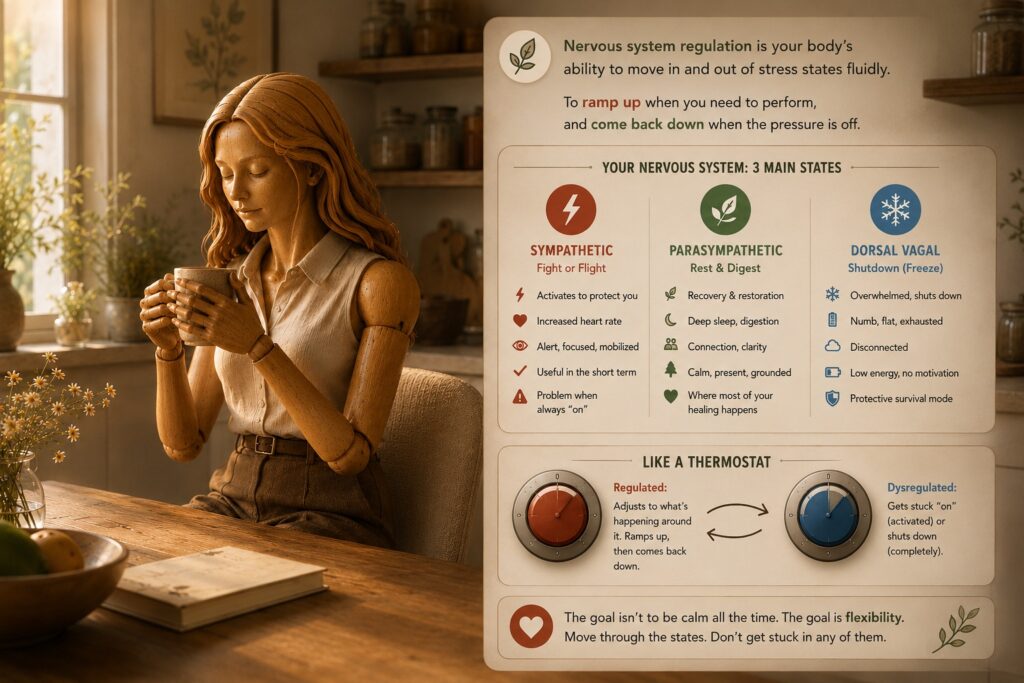
Nervous system regulation is your body’s ability to move in and out of stress states fluidly. To ramp up when you need to perform, and come back down when the pressure is off.
Think of it like a thermostat. A regulated nervous system adjusts to what’s happening around it. Stressful meeting? It activates. Meeting ends? It settles back down. That’s the system working the way it’s supposed to.
Dysregulation is when the thermostat gets stuck. Either the heat never turns off (you’re always “on,” always alert, always bracing for the next thing), or the system shuts down completely (you feel numb, flat, exhausted, unable to find motivation for things you used to love).
Neither state is a character flaw. Both are just your nervous system doing what it was designed to do: protect you. In a world that wasn’t designed to give it much of a break.
A quick tour of your nervous system (I promise this won’t hurt)
Your autonomic nervous system runs in the background 24/7. You don’t consciously control it. It controls your heart rate, digestion, breathing, and how safe or unsafe you feel in any given moment.
It has two main modes you’ve probably heard of:
Sympathetic nervous system — the “fight or flight” side. This is your mobilization system. It’s what kicks in before a big presentation, when you’re in an argument, or when you hear a strange noise at night. It’s not bad. You need it. The problem is when it never fully switches off.
Parasympathetic nervous system — the “rest and digest” side. This is your recovery system. It’s what lets you sleep deeply, digest food properly, connect with people you love, and think clearly. Most chronically stressed people spend very little time here.
There’s a third state worth knowing about, thanks to researcher Dr. Stephen Porges and his polyvagal theory: dorsal vagal shutdown. This is what happens when your system gets so overwhelmed that it stops activating and goes into freeze mode instead. If you’ve ever felt so exhausted you couldn’t make a simple decision, or emotionally flat during moments that should feel good, that’s often what’s happening.
The goal of nervous system regulation isn’t to stay calm all the time. That’s not realistic, and honestly, it’s not even the point. The goal is flexibility: the ability to move through these states without getting stuck in any of them.
What dysregulation actually feels like
This is the part people don’t usually talk about, because dysregulation doesn’t always look like what you’d expect.
It doesn’t always look like crying in the bathroom or having a panic attack. A lot of the time, it looks like being highly functional and deeply exhausted at the same time.
Here are some of the more common signs:
On the activated (sympathetic) side:
- You’re tired, but your mind won’t slow down at night
- You feel a low hum of anxiety even when nothing specific is wrong
- Small things set you off more than they should
- You’re always “on,” always thinking about the next thing, the next problem, the next task
- You can’t really enjoy downtime because your brain is still running in the background
- Your shoulders live somewhere near your ears
On the shutdown (dorsal vagal) side:
- You feel emotionally flat or disconnected
- You’re exhausted but sleep doesn’t fix it
- Things that used to excite you feel like effort
- You go through the motions but feel like you’re watching your life from the outside
- Decision fatigue is intense and even small choices feel overwhelming
A lot of high-achieving women experience a cycle between both: pushing hard in sympathetic activation all week, then crashing into a kind of shutdown on weekends or during vacations. If you’ve ever thought “why can’t I just relax?” on a holiday you worked hard for, this is probably why.
Why “just calm down” doesn’t work
Here’s the thing about nervous system dysregulation: it’s not happening in your mind. It’s happening in your body.
Your nervous system stores patterns. When you’ve been in high-stress mode for months or years, juggling a demanding career, family responsibilities, the pressure to keep it all together, your body starts treating that level of activation as the baseline. It stops recognizing it as stress. It just thinks that’s how life is.
So telling yourself to relax, or taking a meditation class, or going on a yoga retreat can help. But these approaches often don’t stick, because they’re addressing the thoughts without addressing the body that’s running the show underneath.
That’s why traditional stress advice like “practice gratitude” or “think positive” often feels frustrating to high-achievers. You’re not bad at gratitude. Your nervous system is just running an old program, and you need more than a mindset shift to update it.
What actually works is working with your body: teaching your system new patterns through repeated, embodied experience. This is what somatic practice, nervous system coaching, and body-based tools are all about.
How to start regulating your nervous system
The good news: you don’t need to overhaul your life. Small, consistent practices done regularly have a compounding effect on your nervous system. Here’s where to start.
1. Slow your exhale
Your exhale activates your parasympathetic nervous system. A longer exhale than inhale is one of the fastest ways to signal to your body that you’re safe. Try breathing in for 4 counts, out for 6 to 8. Do this for two minutes and notice what shifts.
2. Orienting
This one sounds almost too simple. Slowly look around the room you’re in, letting your eyes rest on things rather than scanning quickly. This is a polyvagal-based practice. It tells your nervous system “I’ve scanned for threats and I’m okay.” Many people find this more effective than breathwork for acute moments of anxiety.
3. Grounding through sensation
Feel your feet on the floor. Feel the weight of your body in your chair. Press your palms together. Physical sensation anchors you into your body and out of the spiral of your thoughts. It works because it gives your nervous system real-time sensory information that you’re present and physically safe.
4. Notice your patterns, without judgment
Start paying attention to when you shift states. When do you feel activated? When do you feel shut down? What happens in your body right before you snap at someone, or before you go completely blank? Awareness is the first step to change. You can’t regulate something you can’t feel yet.
5. Rest that actually restores
Not all rest is created equal. Scrolling your phone in bed activates your stress response. Real rest, the kind that actually restores your nervous system, looks like time without demands, without screens, and without performance. A slow walk. Sitting in sunlight. Time with a person who genuinely feels safe to you.
The bottom line
Nervous system regulation is the foundation that everything else sits on: your sleep, your relationships, your decision-making, your energy levels, and your ability to actually enjoy the life you’ve worked so hard to build.
You can keep pushing through. A lot of people do. But there’s a different way, one that doesn’t require you to choose between ambition and your health.
If any of this resonated, and you’re wondering what it would look like to actually work on your nervous system in a structured, supported way, I’d love to talk.
No pressure, no pitch. Just a conversation about where you are and whether working together makes sense.
I work with high-achieving women as a nervous system coach and consultant to reduce stress, restore balance, and create sustainable success. As an external collaborator with Stanford Cardiovascular Health, I integrate neuroscience, somatic practices, attachment theory, and parts work into my coaching.