If you find yourself snapping at your partner over small things, lying awake at 2 a.m. with your thoughts racing, or feeling completely drained by a workday that should have been manageable, your nervous system may be stuck in survival mode. Learning how to regulate your nervous system is not a luxury. It is the foundation of every other health habit you are trying to build.
The good news is that your nervous system is not fixed. It is flexible, trainable, and responsive to the right inputs. Below are seven evidence-based techniques that calm the body from the inside out, grounded in polyvagal theory and somatic research.
What Does It Mean to Regulate Your Nervous System?
Your autonomic nervous system runs in the background of everything you do. It controls your heart rate, digestion, breathing, and your sense of safety. When it perceives a threat, real or imagined, it shifts into sympathetic activation (fight or flight) or dorsal vagal shutdown (freeze). Nervous system regulation means guiding yourself back to a ventral vagal state: calm, connected, and grounded.
This is not about forcing yourself to feel fine. It is about giving your body the biological cues it needs to feel safe.
7 Evidence-Based Ways to Regulate Your Nervous System
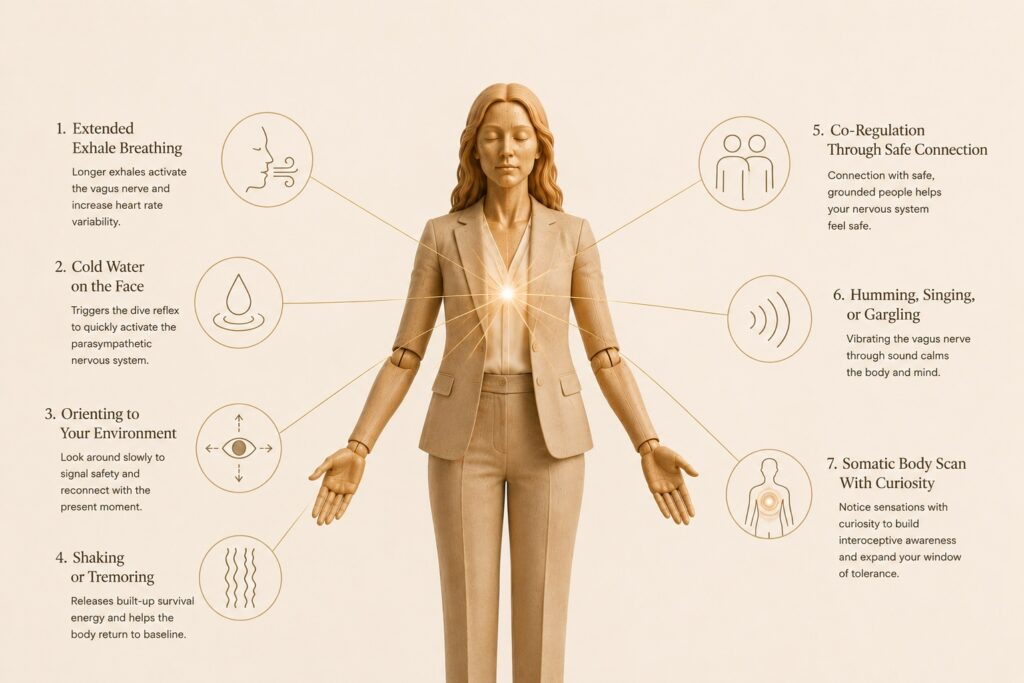
1. Extended Exhale Breathing
Your exhale directly activates the vagus nerve and slows your heart rate. A simple way to regulate your nervous system quickly is to make your exhale longer than your inhale.
Try this: inhale for four counts, exhale for six to eight counts. Repeat for two to three minutes. Research published in the journal Psychophysiology found that this type of paced breathing significantly increases heart rate variability (HRV), a key marker of nervous system flexibility.
2. Cold Water on the Face
Splashing cold water on your face or dipping your face in cold water triggers the mammalian dive reflex, which rapidly slows the heart rate and activates the parasympathetic nervous system. This is one of the fastest ways to regulate your nervous system in an acute stress moment.
You do not need a cold plunge. A bowl of cold water with a few ice cubes is enough. Hold your breath and submerge your face for 15 to 30 seconds.
3. Orienting to Your Environment
Orienting is a somatic technique drawn from Somatic Experiencing, developed by Dr. Peter Levine. It involves slowly turning your head and eyes to notice what is in your physical environment, the way an animal does when it is scanning for safety after a perceived threat.
When you consciously orient, you are sending a signal to your nervous system that the environment is safe. Try it now: turn your head slowly, let your eyes land on objects, and name them silently. Notice the colors, the shapes, the distance. Most people feel a physical shift within 60 seconds.
4. Shaking or Tremoring
Animals discharge stress through physical tremoring after a threat passes. Humans do the same, but we are often socialized to suppress it. Intentional shaking, standing and letting your body vibrate from your knees up, can help your nervous system complete the stress response cycle and return to baseline.
Dr. David Berceli developed Tension and Trauma Releasing Exercises (TRE) around this principle. A 2015 study found that regular TRE practice reduced PTSD symptoms and self-reported stress in participants.
5. Co-Regulation Through Safe Connection
Your nervous system does not regulate in isolation. It co-regulates, or syncs with the nervous systems of calm, safe people around you. This is why talking to a friend who is grounded, getting a hug, or even sitting near someone you trust can shift your physiological state.
If you cannot access another person, listening to a calm, warm voice through a podcast or guided meditation can offer a partial co-regulatory signal. The key is felt safety, not just logic.
This is also the mechanism behind somatic coaching. Working with a practitioner supports your nervous system in learning new patterns through relational safety.
6. Humming, Singing, or Gargling
The vagus nerve runs through your throat, and vibrating it through sound is a direct way to regulate your nervous system. Humming, chanting, singing, or even gargling with water stimulates the vagal branches and creates a calming effect throughout the body.
You do not need to be a singer. Simply humming a song you love for two to three minutes is enough to produce a measurable shift. Dr. Stephen Porges, who developed polyvagal theory, has noted the role of prosodic (melodic) voice in shifting autonomic state.
7. Somatic Body Scan With Curiosity
A traditional body scan asks you to relax each part of your body. A somatic body scan asks you to notice what is actually there, without trying to change it.
Sit comfortably and move your attention slowly through your body, from your feet upward. When you notice tension, tightness, or discomfort, get curious rather than corrective. Ask: where exactly is this? What shape does it have? Is it moving or still? Does it have a temperature?
This approach, rooted in interoceptive awareness, trains your nervous system to tolerate sensation rather than brace against it. Over time, this builds what somatic practitioners call window of tolerance, the range in which you can feel activated without becoming dysregulated.
The Most Important Thing to Know About Nervous System Regulation
Nervous system regulation is a practice, not a fix. One breathing session will not undo years of chronic stress. But consistent, small inputs of safety, repeated daily, reshape how your nervous system responds to life.
If you want to go deeper, my work offers a relational, body-based approach to healing nervous system dysregulation at the root. I work with clients one-on-one to build lasting regulation capacity.
Ready to start? Book a free discovery call and take the first step toward a more regulated life.