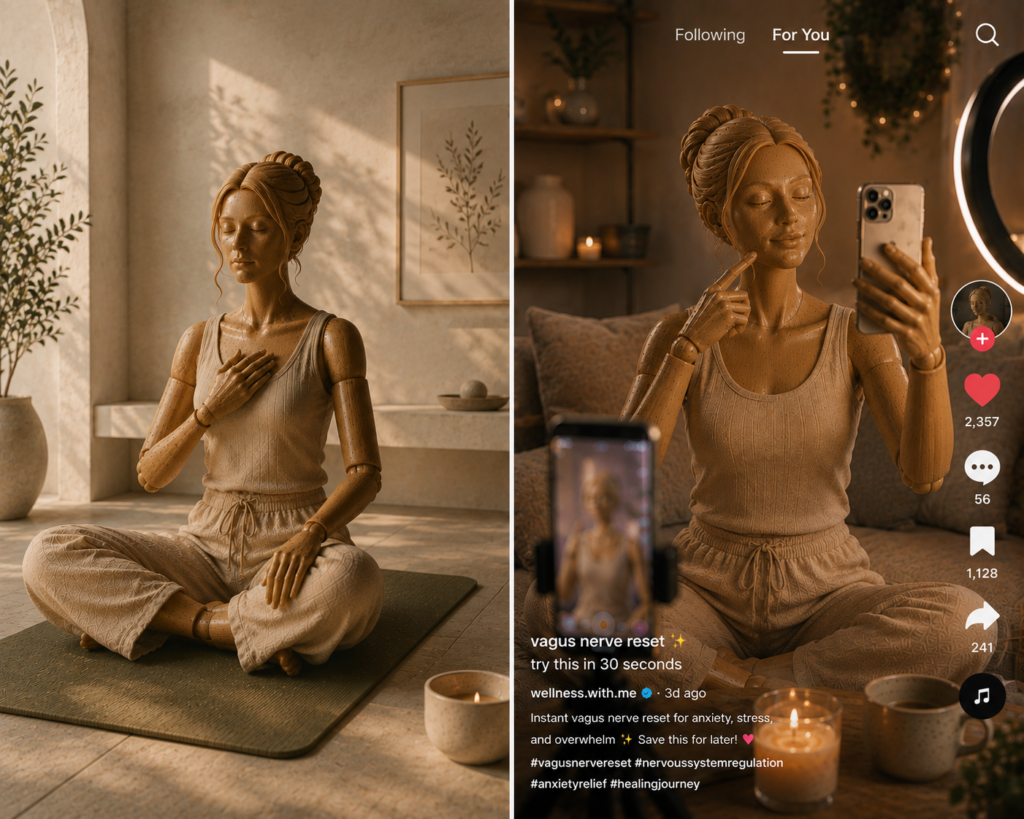
If your For You Page has been invaded by people humming at their collarbone, massaging their necks, and calling it “nervous system regulation,” you’re not alone. Vagus nerve exercises have become TikTok’s favorite wellness topic, which means they’ve also become a dumping ground for pseudoscience.
Here’s the thing: the vagus nerve is genuinely fascinating, and vagus nerve exercises do have real, measurable effects on how you feel. The problem is that “real science” and “girl pressing her jaw in a parking lot” are sharing the same hashtag.
So let’s separate the two.
What Is the Vagus Nerve, Actually?
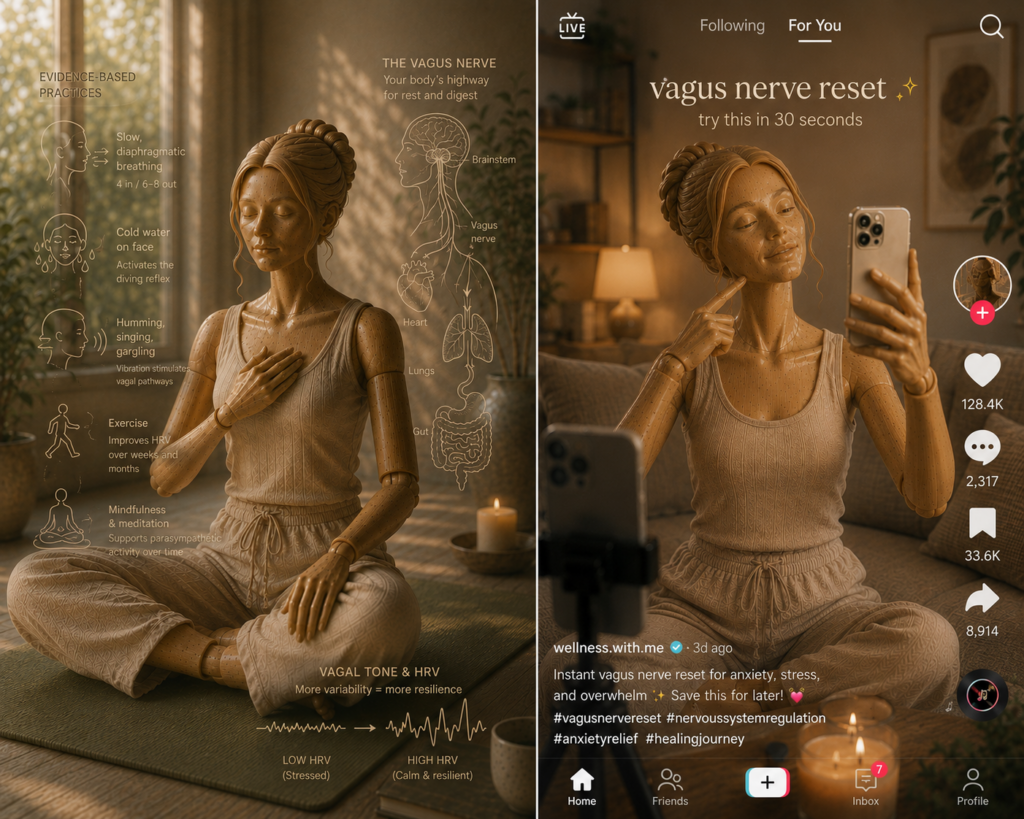
The vagus nerve is the longest cranial nerve in your body. It runs from your brainstem down through your neck, heart, lungs, and gut. It’s the main highway of your parasympathetic nervous system, the “rest and digest” branch that counteracts the stress response.
When it’s functioning well, you recover from stress faster, sleep better, and feel more emotionally regulated. When it’s not, chronic stress, anxiety, and even digestive issues can follow.
Vagal tone is essentially how robust and flexible that nerve’s response is. It’s measurable through heart rate variability (HRV), the variation in time between your heartbeats. Higher HRV generally means your nervous system is more adaptable and resilient. That’s real. That’s evidence-based. Worth knowing.
Now for the fun part.
Vagus Nerve Exercises That Actually Work
Slow, Diaphragmatic Breathing
This is the most well-supported vagus nerve exercise available, and the research has only gotten stronger. A 2022 systematic review and meta-analysis found that voluntary slow breathing consistently increases HRV and shifts autonomic balance toward parasympathetic dominance. A 2021 study in Scientific Reports went further, showing that even a single session of deep, slow breathing measurably increased vagal tone and reduced state anxiety in both younger and older adults.
The mechanism is straightforward: slow breathing at around 5 to 6 breaths per minute activates baroreceptors in your chest and neck, which signal the brainstem to dial down sympathetic activity. Try a 4-count inhale and a 6-to-8-count exhale. No app required. Five minutes is enough to see an effect.
Cold Water on Your Face
Sounds dramatic. Has solid science behind it. A 2023 meta-analysis in Psychophysiology reviewed 17 studies and found a significant moderate-to-large effect of the diving response on cardiac vagal activity, measured by RMSSD, a standard HRV marker. A 2022 study in Scientific Reports confirmed that the cold face test, simply applying cold water to the face, reduces acute stress responses through vagal activation.
The mechanism runs through the trigeminal nerve. Cold receptors in your face trigger a reflex arc that signals the vagus nerve via the brainstem, producing rapid bradycardia and a parasympathetic shift. It works fast. We’re talking seconds, not sessions.
Humming, Singing, or Gargling
The muscles of the larynx and pharynx share anatomy with the vagus nerve. Activating them through humming, singing out loud, or gargling creates vibration that directly stimulates vagal pathways. This is the actual physiological basis for why chanting has been used in contemplative practices for centuries.
The research here is less formalized than breathing, but the anatomical basis is sound and consistent with broader findings on how physical vibration in the throat region engages the vagus. A few minutes of humming in the car counts. You don’t have to chant at anyone.
Exercise
Nothing glamorous here. Consistent aerobic activity is one of the strongest long-term interventions for vagal tone, and it works through cumulative HRV improvement over weeks and months rather than acute effects. It won’t fit a 15-second tutorial. It works anyway.
Mindfulness
Mindfulness doesn’t have to mean sitting cross-legged with your eyes closed for 20 minutes.
At its simplest, mindfulness is the practice of bringing attention to what’s happening in the present moment. A 2025 systematic review in Applied Psychophysiology and Biofeedbackfound that brief mindfulness meditation interventions can increase HRV in adults, though the authors noted that effects vary depending on meditation type, duration, and how HRV is measured.
And for the high achiever, I actually prefer starting with simple, sensory-based mindfulness rather than jumping straight into formal meditation.
A nervous system accustomed to constant productivity, anticipation, problem-solving, and sympathetic mobilization may find sitting completely still, closing the eyes, and focusing intensely on internal sensations surprisingly challenging. Meditation can be incredibly valuable, but for some nervous systems, it’s a more advanced practice and not necessarily the starting point.
Mindfulness can be much simpler.
Feel your feet on the ground while you’re waiting for your coffee.
Notice the temperature of the water in the shower.
Let yourself actually taste your lunch instead of answering emails through it.
Look around the room and notice what your eyes land on.
Listen to the sounds around you while you’re walking instead of mentally rehearsing the next conversation.
Notice the sensation of your body against the chair before your next meeting.
For a high-achieving nervous system that’s accustomed to living five steps ahead, bringing attention back to sensory information happening right now can itself be a meaningful practice.
You don’t have to stop your thoughts.
You don’t have to force yourself to feel calm.
And you don’t need a 30-minute morning routine.
Start by giving your nervous system more opportunities to experience the moment you’re actually in.
Vagus Nerve Exercises That Don’t Hold Up
“Vagus Nerve Resets” and Neck Massage Protocols
A new video surfaces every few weeks showing someone pressing specific points on their neck, jaw, or skull and claiming it “resets” the nervous system. The polyvagal theory, developed by Dr. Stephen Porges, is real and important. The pop-science interpretations circulating on TikTok are not.
There is no established protocol for manually resetting your vagus nerve via touch points. Massage can be relaxing, and relaxation does calm the nervous system. But “this made me feel calm” is not the same as “this stimulated my vagus nerve.” Correlation isn’t mechanism.
Eye Exercises That Claim to “Reset” the Vagus Nerve
Eye movement and visual orientation exercises can be legitimate nervous system practices, and I use them with my own clients. Vision provides important sensory information about our environment and can influence nervous system state. Where the science gets stretched is claiming that a specific eye movement directly “resets” the vagus nerve. The evidence for that mechanism is thin.
Tapping (EFT)
Emotional Freedom Technique, which involves tapping on meridian points, has some small studies showing self-reported anxiety reduction. But attributing that effect to the vagus nerve specifically is retrofitting a trendy explanation onto an unrelated practice. The mechanism doesn’t hold up.
The Bottom Line
The vagus nerve is real. Vagal tone is measurable. The vagus nerve exercises that actually move the needle are breathing, cold exposure, sound, movement, and mindfulness. Each of these has a documented mechanism and peer-reviewed evidence behind it.
What they don’t have is a 15-second tutorial format. That’s why TikTok keeps reaching for something more dramatic.
Do the boring stuff consistently. It works.
Ready to explore what it looks like to do this work with support? Book a free discovery call → and let’s talk about what your nervous system might need next.