
This story is a composite drawn from the experiences of several clients I have worked with. Names and identifying details have been changed to protect their privacy.
When Elizabeth first reached out to me, she opened with an apology. “I am not sure this is the right fit,” she wrote. “I am not in crisis, just really tired.”
Elizabeth was a VP of operations at a fast-growing tech company. She managed a team of 40, sat on two internal steering committees, and had just led her department through a reorganization. On paper, she was thriving. Her last performance review called her “the steady hand in every storm.”
In her body, a different story was unfolding. If you are a high-achieving woman who looks fine from the outside, this executive burnout case study may feel familiar.
The Problem: Burnout That Looked Like Success
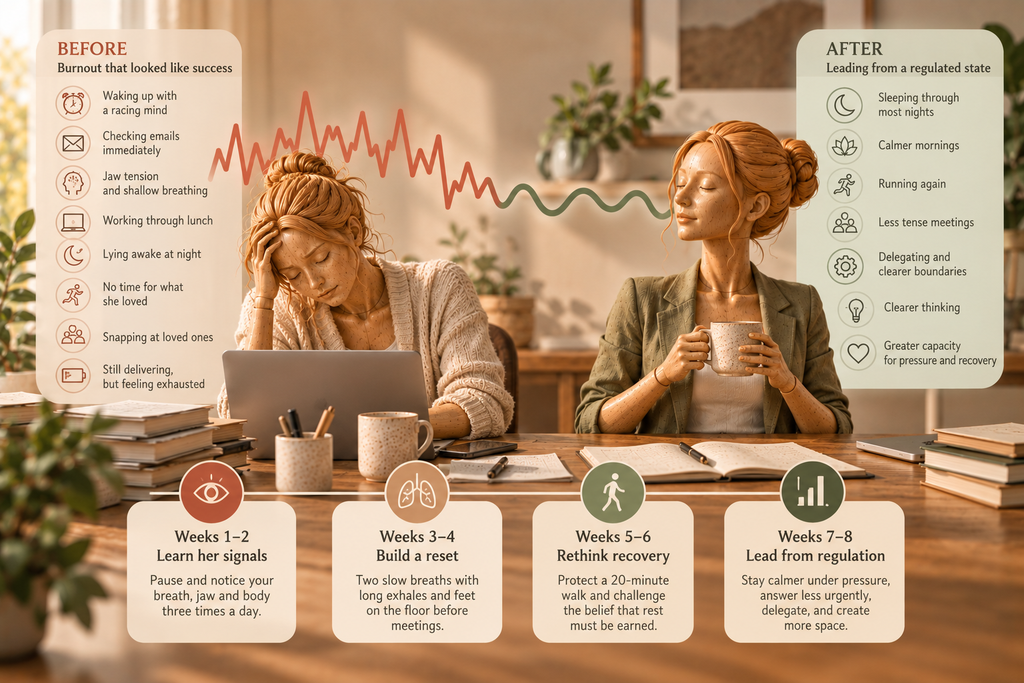
Elizabeth described her days like this. She woke at 4:45 a.m. with her heart already racing. She checked Slack before she got out of bed. By mid-morning, her jaw ached from clenching. She ate lunch at her desk, if she ate at all. At night, she lay awake replaying conversations and drafting emails in her head.
She had stopped running, something she had loved for 15 years. Weekends felt like recovery time that never quite worked. And she had started snapping at her partner over small things, which scared her more than anything.
The World Health Organization describes burnout as a syndrome caused by chronic workplace stress that has not been successfully managed. It has three markers: exhaustion, growing cynicism or distance from your work, and a drop in your sense of effectiveness. Elizabeth had all three. She just had not named them, because she was still delivering.
This is what I see so often with women in leadership. Your performance becomes the last thing to break. By the time it does, your nervous system has been running on emergency power for months, sometimes years.
What Was Really Happening in Her Nervous System
In our first sessions, we did not talk much about her calendar. We talked about her body.
I asked Elizabeth to notice what happened when she opened her inbox. Her shoulders rose, and her breath moved up into her chest. Within seconds, her hands went cold. These were not personality quirks. They were signs of a nervous system stuck in fight or flight.
When your stress response stays switched on, your body treats every meeting like a threat. Your thinking narrows. Rest feels unsafe, so you cannot settle even when you finally have time. That is why Elizabeth’s weekends did not restore her. Her body never got the signal that the danger had passed.
The real problem was not that she was working too hard. It was that she had lost the ability to come back down after working hard.
The Turning Point: Small Shifts, Practiced Daily
Elizabeth expected me to tell her to take a sabbatical. Instead, we started with three minutes a day.
Here is what her first eight weeks looked like.
Weeks 1 to 2: Learning her signals. Elizabeth set three phone reminders a day. Each time, she paused and asked herself, “Where is my breath right now? What is my jaw doing?” Nothing to fix. Just noticing.
Weeks 3 to 4: Building a reset. We added a simple practice: two slow breaths with long exhales, followed by pressing her feet into the floor. She did this before every leadership meeting. It took less than a minute.
Weeks 5 to 6: Rethinking recovery. Elizabeth realized she had been treating rest as something she had to earn. We explored where that belief came from and what a part of her feared would happen if she slowed down. She began protecting a 20-minute walk after lunch, phone in her pocket.
Weeks 7 to 8: Leading from a regulated state. This is where things shifted at work. Elizabeth noticed she could stay calm when a project went sideways. She stopped answering every message instantly. She delegated a committee seat she had held out of obligation.
None of these changes were dramatic. That was the point. A nervous system learns safety through repetition, not through one big gesture.
The Results: Leading Sustainably
Six months after we began, Elizabeth still had a demanding job. The work did not get easier. Her capacity to meet it changed.
She told me she was sleeping through most nights. She had started running again, three mornings a week. Her team noticed too. One of her direct reports told her that meetings felt “less tense” and that people were bringing her problems earlier.
Maybe the biggest shift was internal. “I used to think my value came from how much I could carry,” Elizabeth said in one of our last sessions. “Now I think it comes from how clearly I can see.”
That is what leading sustainably means to me. It is not about doing less forever. It is about building a nervous system that can handle pressure and then return to steady ground.
What Elizabeth’s Story Can Teach You
You do not have to wait until you hit a wall to make a change. If any of this sounds like you, start here:
- Notice before you fix. Check in with your breath and jaw three times a day.
- Create a 60-second reset. A long exhale and your feet on the floor can shift your state before a hard conversation.
- Question the rule that rest must be earned. Your body does not recover on a schedule set by your inbox.
- Measure success by your recovery, not only your output. Ask yourself how quickly you return to calm after a stressful day.
You Do Not Have to Do This Alone
Burnout recovery is not a sign that you failed. It is a sign that your body has been protecting you for a long time and is ready for a different way.
In my work, I help high-achieving women like Elizabeth move from survival mode to leadership that lasts. If her story felt familiar, I would love to hear yours.
No pressure, no pitch. Just a conversation about where you are and whether working together makes sense.