
You did everything right. You worked hard, delivered results, held it together through the hard seasons. And somewhere along the way, your body started sending signals you didn’t have time to hear.
Now you’re here: exhausted but wired, running on fumes but unable to slow down, wondering if you’ll ever feel like yourself again.
Burnout recovery for high-achieving women is not about doing less. It’s about learning a fundamentally different way to relate to your body, your nervous system, and the relentless drive that got you here in the first place.
This guide will walk you through what burnout actually is at a physiological level, why high-achieving women are uniquely vulnerable to it, and what real recovery looks like from the inside out.
What Burnout Actually Does to Your Body
Burnout is not a mindset problem. It is not laziness, weakness, or a sign that you need a better productivity system.
Burnout is a physiological state. When you spend months or years operating in chronic stress, your nervous system gets locked into a pattern of threat response. Your body stays primed for danger even when the “danger” is just your inbox.
The result is a system that cannot regulate itself. You feel exhausted but cannot rest, numb but unable to feel. Even the things that used to bring joy return nothing.
This is your nervous system trying to protect you. It has learned that the world is not safe to slow down in, so it keeps you mobilized. The problem is that you were never meant to live there permanently.
Understanding this matters because it shapes everything about recovery. Specifically, you cannot think your way out of a dysregulated nervous system. You have to work with the body directly.
Why High-Achieving Women Burn Out Differently
High-achieving women often burn out in a particular way that gets missed, even by themselves.
Because you are capable, you keep going long past the point where someone else would stop. Because you are used to pushing through, you interpret exhaustion as something to overcome rather than something to listen to. Because your identity is often tied to your output, slowing down can feel like losing yourself.
Many of the women I work with describe the same pattern: years of overriding body signals in service of goals, relationships, or simply the pressure to keep up. The burnout doesn’t announce itself dramatically. It creeps in. First the joy leaves. Then the energy. Then the sense of purpose.
There is also a layer that rarely gets discussed: the way high-achieving women carry other people’s emotional weight. If you are the one who holds things together at work, at home, in your relationships, your nervous system is doing double duty. You are not just managing your own stress. You are regulating around everyone else’s too.
This is a nervous system dysregulation pattern, and it has a body-based solution.
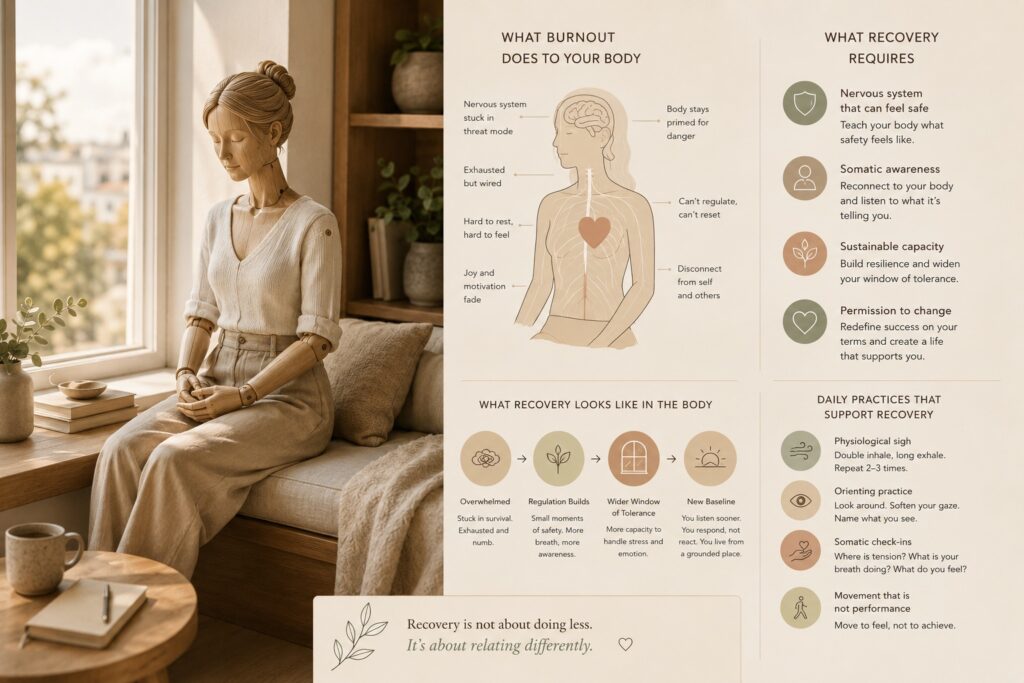
What Burnout Recovery for High-Achieving Women Actually Requires
Most burnout recovery advice focuses on rest and boundaries. Those matter. But they are not sufficient on their own.
Here is what genuine recovery requires.
1. A Nervous System That Can Feel Safe
Rest only restores you if your nervous system can receive it. Many high-achieving women try to take time off and find themselves more anxious, not less. The nervous system does not know how to downshift because it has been in high gear for so long.
The first work of recovery is not doing less. It is teaching your body what safety feels like. This happens through small, consistent inputs: gentle movement, intentional breath, time in nature, co-regulation with safe people, and body-based practices that signal to your system that the threat has passed.
2. Somatic Awareness
Burnout disconnects you from your body. Recovery means learning to reconnect.
Somatic awareness is the practice of noticing physical sensations without immediately trying to fix them. What does tension feel like in your shoulders? What happens in your chest when you receive good news? Where do you carry stress?
This is not navel-gazing. In fact, it is data. Your body is constantly communicating, and burnout recovery accelerates when you learn to listen.
If you are new to this, our post on somatic coaching versus therapy can help you understand how body-based approaches differ from traditional talk therapy.
3. Sustainable Capacity, Not Just Recovery
Here is the piece that most burnout recovery frameworks miss: rest alone does not build resilience.
If you rest until you feel okay and then return to the same conditions that burned you out, you will burn out again. The goal is not to recover to your previous baseline. The goal is to build a nervous system with more capacity, more flexibility, and better access to its own regulation signals.
This is what polyvagal theory teaches us. A regulated nervous system is not one that never gets activated. Rather, it is one that can move fluidly between states and return to baseline after stress. That capacity is buildable. It takes practice, but it is absolutely possible.
4. Permission to Change
This one is subtle but important. Many high-achieving women approach burnout recovery as a project to complete so they can get back to performing at full capacity. Recovery becomes another thing to optimize.
Real recovery often asks for something harder: a genuine renegotiation of how you live and work. Not necessarily doing less, but doing it differently. In practice, that means building structures that support your nervous system rather than consistently override it.
This is not about becoming someone who produces less. It is about becoming someone who produces sustainably, from a grounded place, without burning the house down to do it.
What Recovery Looks Like in the Body
Burnout recovery is not linear. Most people move through stages, and the transition points can feel disorienting.
In the early stages, rest can feel uncomfortable or even frightening. This is normal. Your nervous system has been running hot for so long that stillness registers as a threat. Give it time.
As regulation starts to build, you may notice small things first. Sleep that actually restores you. Moments of genuine pleasure that do not feel guilty. A breath that goes all the way down. These are nervous system milestones, and they matter.
Later stages involve rebuilding access to what Peter Levine and other somatic researchers call your “window of tolerance.” This is the zone in which you can experience stress, challenge, and strong emotion without tipping into overwhelm or shutdown. A wider window means more resilience, not less sensitivity.
The signs of nervous system dysregulation that showed up during burnout gradually soften. You are not the same person you were before burnout. Instead, you become someone who knows her system better, listens to it sooner, and has tools to come back when life gets hard.
Daily Practices That Support Burnout Recovery
You do not need a dramatic intervention. Instead, you need consistent, small inputs of safety, repeated over time.
Physiological sigh. A double inhale through the nose followed by a long exhale through the mouth. This is one of the fastest ways to activate the ventral vagal state and shift your nervous system out of high alert. Two or three repetitions can shift your state noticeably.
Orienting practice. Slowly look around the room. Let your gaze soften and settle on objects. Name what you see. This simple practice activates the social engagement system and signals to your body that you are not in danger.
Intentional rest. Not scrolling. Not podcasts. Lying down with no input, even for ten minutes, teaches your nervous system that it is safe to be still.
Somatic check-ins. Once or twice a day, pause and ask: where do I feel tension? What is my breath doing? What is the quality of sensation in my body right now? You are not trying to fix anything. You are just noticing.
Movement that is not performance. Walking without tracking it. Stretching without it being a workout. Shaking, swaying, dancing alone in your kitchen. Expressive, non-goal-oriented movement helps discharge stored stress from the body.
These practices are small. That is the point. Rather than overhauling your life in a weekend, you are building a new relationship with your own system, one day at a time.
The Most Important Thing to Know About Burnout Recovery
Burnout recovery is a practice, not a fix. One restorative weekend will not undo years of chronic stress. But consistent, small inputs of safety, repeated daily, reshape how your nervous system responds to life.
The women I work with who make the deepest recoveries are not the ones who found the perfect protocol. They are the ones who committed to showing up for their bodies the way they show up for everything else, with attention, consistency, and care.
If you want to go deeper, my work offers a relational, body-based path to healing nervous system dysregulation at the root. I work with clients one-on-one to build lasting regulation capacity and a sustainable relationship with the ambition that drives them.
Ready to start? Book a free discovery call and take the first step toward a more regulated life.