
You’ve been functioning. Keeping up with work, showing up for people, getting through the days.
But something feels off. You’re tired even when you’ve slept. You can’t unwind even when nothing is technically wrong. You snap at people you love and then feel terrible about it. You live in a low-grade state of brace.
Here’s the thing: that’s not a personality problem. It’s not burnout from working too hard this quarter. And it’s definitely not something you can fix by going to bed earlier or downloading a meditation app.
It’s your nervous system. And it’s been stuck.
Nervous system dysregulation doesn’t always look dramatic. It’s rarely one big collapse. More often, it’s a quiet collection of symptoms that you’ve slowly normalized because everyone around you seems to be living the same way.
But normalized doesn’t mean okay.
Here are 12 signs your nervous system might be dysregulated, and what they’re actually telling you about what’s happening in your body.
First, a quick orienting note
Your nervous system has two main modes. The sympathetic side activates when there’s a threat (fight or flight). The parasympathetic side helps you rest, digest, and restore.
A regulated nervous system moves between these states fluidly. It ramps up when you need it to, and comes back down when the pressure is off.
Dysregulation is when it gets stuck. Either locked in high-alert (always “on,” always scanning for the next problem), or shut down completely (flat, numb, exhausted in a way that rest doesn’t touch). Sometimes it flips between both.
The signs below map to both ends of that spectrum. You might recognize yourself in one cluster, or in both.
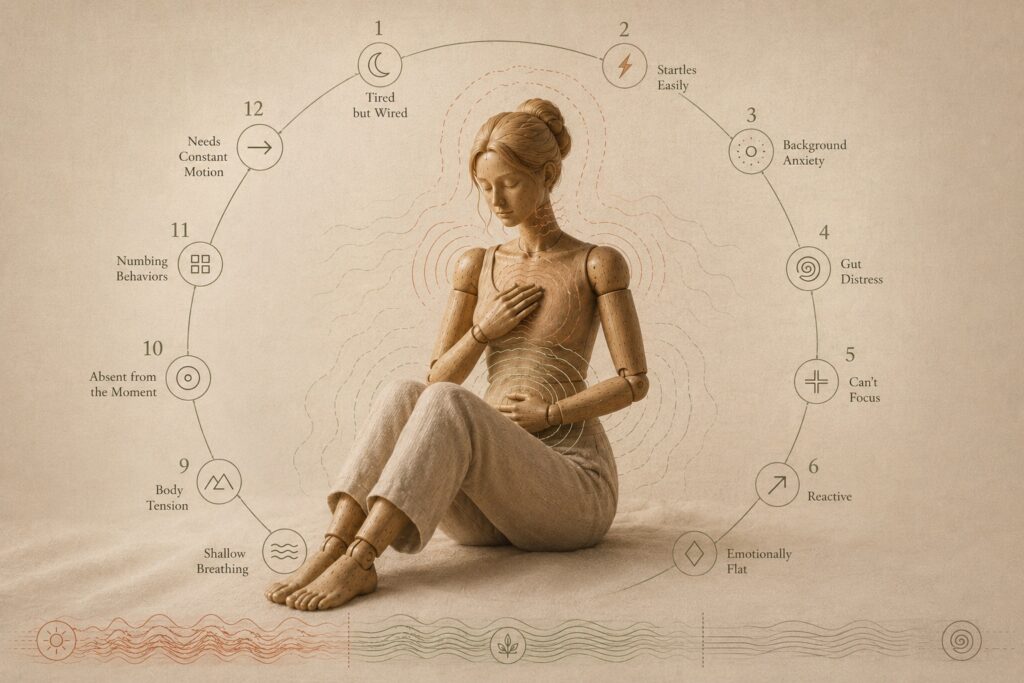
12 signs of nervous system dysregulation
1. You’re tired all the time, but you can’t sleep
You hit a wall at 3pm. You’re yawning through your evening. You finally lie down. And suddenly your brain has opinions about everything that happened in 2019.
This is one of the most common dysregulation patterns. Your cortisol curve flips: high when it should be low (bedtime), low when it should be high (morning). Your body isn’t being difficult. It’s stuck in vigilance mode and doesn’t know how to downshift.
2. You startle easily
A phone buzzes across the room. Someone walks up behind you. A car backfires outside.
Your heart jumps. Your shoulders shoot up. It takes a beat to settle.
A regulated nervous system filters sensory input and determines what’s actually a threat. When the system is dysregulated, it flags everything. Your threat-detection filter is turned up too high, and your body responds to small things like they’re large things.
3. You feel anxious without a clear reason
Not anxious about anything specific. Just… anxious. A low hum of dread. A vague sense that something is about to go wrong.
This isn’t irrational, and it’s not all in your head. When your nervous system is in a chronic state of activation, it generates anxious feelings as a signal. The problem is that the signal has become background noise. There’s no event attached to it anymore. It’s just the weather inside your body.
4. Your digestion is a mess
Nervous system dysregulation shows up in the gut more than most people realize. IBS-type symptoms, bloating, nausea, constipation, or the feeling that your stomach is in knots even when you haven’t eaten anything new.
The gut and the nervous system are deeply connected (the vagus nerve runs between them). When you’re stuck in fight-or-flight, your body deprioritizes digestion. It’s focused on surviving, not processing lunch.
5. You can’t focus, no matter how hard you try
You sit down to work. You’re not distracted by anything in particular. But you can’t land. You re-read the same paragraph. You start three things. You finish none of them.
This isn’t a discipline problem. When the nervous system is dysregulated, the brain’s prefrontal cortex (the part responsible for focus, planning, and decision-making) gets less blood flow. Your body is in survival mode. Survival mode doesn’t prioritize your to-do list.
6. Small things make you disproportionately reactive
The WiFi goes down. Someone is chewing loudly. A plan changes last minute.
And you react in a way that, in retrospect, feels bigger than the situation deserved.
This is a window into your capacity. When your nervous system is already running close to its edge, there’s no buffer for minor irritations. The small things tip you over because there’s no room left.
7. You feel emotionally numb or flat
This is the other end of the dysregulation spectrum, and most people miss it.
You’re not overwhelmed. You’re just… not much of anything. Things that used to excite you don’t really land. You go through the motions of your life without feeling particularly present in it. You wonder if something is wrong with you for not feeling more.
This is dorsal vagal shutdown: your nervous system’s last-resort protection when it’s been running too hot for too long. It’s not depression, exactly. It’s your system hitting the emergency brake. And it’s just as much a sign of dysregulation as anxiety is.
8. You hold your breath, or breathe shallowly, without realizing it
Check right now: how’s your breathing?
Shallow chest breathing, breath-holding, or constant sighing all signal a nervous system running in alert mode. Your breath is one of the fastest feedback loops between your body and your nervous system. And when the system is dysregulated, the breath reflects it.
9. Your body is always tense somewhere
Jaw. Shoulders. Chest. Hips. Belly.
You may not notice it during the day, but you notice it when someone mentions it. Or when you finally slow down long enough to scan.
Chronic muscle tension is your body holding what it can’t process. Your nervous system stores unresolved stress physically. This is why yoga helps (briefly), but doesn’t fully resolve it. The tension isn’t just in your muscles. It’s in your nervous system’s pattern.
10. You struggle to be present
You’re at dinner with people you love. You’re on holiday. You’re in what should be a perfectly good moment.
And part of your brain is somewhere else. Making a list. Rehashing something from earlier. Worrying about next week.
Presence requires safety. When your nervous system doesn’t feel safe (even when your circumstances are objectively fine), it keeps scanning. It keeps running. Being here is hard when your system has learned to stay ahead of the next threat.
11. You rely on numbing behaviors to unwind
Scrolling past the point of enjoyment. Drinking a little more than you meant to. Binge-watching things you’re not that interested in. Eating past fullness.
These aren’t character failures. They’re nervous system strategies. When you can’t get your system to downregulate naturally, you reach for things that do it chemically or through overstimulation. It works, briefly. But it doesn’t restore. And you need more of it over time.
12. You feel better in motion than at rest
Sitting still is uncomfortable. Resting feels like falling behind. Vacations are nice in theory but hard to actually enjoy. You’re more comfortable doing than being.
This one is particularly common in high-achievers. For some people, busyness becomes a dysregulation strategy. Staying in motion keeps the nervous system occupied so it doesn’t have to feel the activated state underneath. The problem is that you can only run that strategy for so long before the system starts to break down.
So what now?
If you recognized yourself in several of these, maybe most of them, the important thing to understand is this: this is not who you are. It’s a pattern your nervous system learned.
And patterns can change.
Nervous system work isn’t therapy, though it can work alongside it. It isn’t meditation (though that can help). It’s learning to work with your physiology instead of trying to think or push your way through it.
The body keeps the score, as they say. But it also holds the path out.
If you want to understand your specific pattern and what would actually move the needle for you, I offer a free discovery call where we can look at what’s driving your dysregulation and what a realistic path forward looks like.
No pressure, no pitch. Just a conversation about where you are and whether working together makes sense.
Laura Larios is a certified somatic practitioner and nervous system coach in San Francisco, with a collaboration credential through Stanford Cardiovascular Health. She works with high-achieving professionals who are functional on the outside and exhausted on the inside.